A golden carpet of dandelions spread across your lawn overnight — and you’re standing there with a weeding tool in one hand and a coffee mug in the other, genuinely unsure what to do next.
You’re not alone. Few plants stir up as much internal conflict as the humble dandelion. Should you yank them? Eat them? Leave them for the bees?
Somewhere between lawn-care perfectionism and wildflower enthusiasm, there’s a sensible middle ground — and that’s exactly what this guide is here to help you find.
Whether you want to embrace dandelions, evict them, or strike a thoughtful compromise, you’ll leave this page with the knowledge to make a confident decision about every single golden bloom in your yard.
What Exactly Is a Dandelion?
The common dandelion (Taraxacum officinale) belongs to the Asteraceae family — the same clan as sunflowers and daisies.
It’s a short-lived perennial that originated in Eurasia and has since naturalized across every continent except Antarctica.

In the British Isles alone, botanists have identified over 200 micro-species, though the differences require a trained eye to spot.
The name “dandelion” comes from the French dent de lion, meaning “lion’s tooth” — a nod to the jagged, deeply lobed leaves that form a ground-hugging rosette.
What most people think of as a single flower is actually an inflorescence: a tightly packed cluster of up to 200 tiny individual florets, each capable of producing a seed.
Those iconic puffball seed heads? Each seed sports a feathery parachute called a pappus that can carry it remarkable distances on the wind — sometimes several hundred meters from the parent plant.

Beneath the surface, the fleshy taproot can extend six to eighteen inches deep in most garden soils, though exceptional specimens reach several feet.
This root is the dandelion’s secret weapon: it stores energy over winter, allows the plant to survive drought, and can regenerate an entirely new plant from a fragment as small as one inch left behind after weeding.
That regeneration ability is the single biggest reason dandelions feel nearly indestructible — and it’s the key fact that should inform every removal method you choose.
Don’t Confuse Them With Look-Alikes
Several plants are commonly mistaken for dandelions, and the distinction matters — especially if you plan to eat what you pick.
1. Cat’s ear (Hypochaeris radicata) is the most common impostor.

Both plants have yellow flowers and windborne seeds, but cat’s ear has branching, solid stems with hairy leaves, while dandelion stems are hollow, unbranched, and leafless with smooth foliage.
2. Coltsfoot (Tussilago farfara) blooms even earlier than dandelions with similar yellow flowers, but its leaves appear after the flowers (the reverse of dandelions), and the flower stems have scales.

Coltsfoot is a genuinely aggressive invasive in parts of North America that crowds out native plants — so correctly identifying it matters.
3. Hawkweeds and hawksbeards also resemble dandelions but have branched, leafy stems.

When in doubt, look for the telltale combination: hollow, leafless, unbranched stem with milky white sap and smooth, lobed leaves in a basal rosette. That’s your dandelion.
A Brief History: From Prized Herb to Public Enemy
Here’s something that might change how you look at your lawn: for most of human history, dandelions were treasured.
- Ancient Egyptians, Greeks, and Romans used them as food and medicine.
- Traditional Chinese medicine has employed them for over a thousand years.
- When European settlers sailed to North America — possibly as early as the Mayflower — they deliberately packed dandelion seeds alongside their medicinal crops. These weren’t accidental stowaways; they were survival supplies.
In earlier centuries, gardeners actually weeded out grass to make room for dandelions. Japanese horticultural societies once formed specifically to cultivate new dandelion varieties.
It wasn’t until the rise of the modern lawn aesthetic in the twentieth century — fueled by suburban expansion and the chemical herbicide industry — that the dandelion was rebranded as public enemy number one.
As the old saying goes, a weed is simply a plant growing where someone has decided it isn’t wanted. By that definition, corn is a weed in a flower bed and roses are weeds in a cornfield.
I think about this sometimes when I’m kneeling in the garden on a spring morning, staring at a dandelion that has pushed through a crack in the patio flagstone.
There’s something almost admirable about a plant that humans have alternately cherished and cursed for millennia, yet keeps showing up uninvited with the same cheerful golden face, completely unbothered by our opinion of it.
The Case for Keeping Dandelions: Real Benefits Worth Knowing
They Support Pollinators — With an Important Caveat
Dandelions are frequently praised as essential pollinator food, and there’s genuine truth to this — but the full picture is more nuanced than the simple “save the bees, save the dandelions” narrative suggests.
Dandelions do provide nectar and pollen to a wide range of insects, including honeybees, bumblebees, solitary bees, butterflies, moths, and hoverflies.

Their value is highest in early spring, when they’re often among the most visible and abundant blooms available — particularly in urban landscapes where intentional pollinator plantings are sparse.
Research confirms that dandelions attract a broad array of pollinator species and can serve as a critical bridge in areas with limited floral diversity.
However, dandelion pollen is not the most nutritious option for bees.
It lacks certain amino acids that pollinators need, and studies have found that honeybees cannot thrive on a dandelion-only diet — it can even impair their ability to rear brood.
The key takeaway? Dandelions are a supplement, not a substitute. They’re the granola bar in the pollinator pantry — helpful in a pinch, but not a balanced meal.
The practical advice: Keep some dandelions around (especially early ones), but also plant a diverse mix of blooms that flower throughout the entire growing season.
Native early-blooming plants like Oregon grape, camas, and crocuses offer superior nutrition for spring pollinators. Dandelions fill a gap; other flowers fill the plate.
 Read about Native Plant Gardening Made Easy: A Step-by-Step Guide for Homeowners
They Improve and Protect Your Soil
This is one of the dandelion’s most underappreciated superpowers. Those stubborn taproots that make them so hard to pull? They’re performing valuable underground work.
As they push deep into compacted earth, they create channels that allow air, water, and earthworms to penetrate — functioning as natural aerators, the biological version of the tool you rent every fall.

Even more impressively, dandelion roots draw minerals like calcium, potassium, and iron from deep soil layers and store them in the leaves.
When those leaves decompose, those nutrients are deposited in the topsoil where shallow-rooted plants — including your grass — can access them.
In essence, dandelions run a one-plant mineral redistribution service for your entire yard.
Above ground, their fast-spreading rosettes shade bare soil, conserve moisture, and help prevent erosion — stepping in as ecological first responders wherever cultivated plants struggle to establish.
This is also why a lawn thick with dandelions often signals specific soil conditions: compaction, low calcium, acidic pH, or excess potassium.
Rather than viewing dandelions purely as a problem, you can read them as a diagnostic message from your soil.
Discover more Proven Dandelion Root Benefits: Nature’s Secret to Better Health
They Feed an Entire Food Web
Beyond pollinators, dandelions support a surprising web of wildlife. The seeds feed goldfinches, sparrows, and other small birds.

The leaves serve as food for caterpillars of several butterfly and moth species — including buff ermine, garden tiger, and ruby tiger moths — which in turn feed birds higher up the food chain.
Hummingbirds use dandelion fluff to line their tiny nests. Beneficial insects and lizards shelter under the flat rosettes.
If you keep backyard chickens, dandelion greens make an excellent treat that supports rich, golden yolks.
This cascade of relationships means dandelions function as a small but meaningful biodiversity engine.
By attracting pollinators that also visit your fruit trees and vegetable garden, a patch of dandelions can benefit your entire yard’s productivity.
The Case for Removing Dandelions: When They Cross the Line
Acknowledging the benefits doesn’t mean you have to let dandelions take over. There are perfectly legitimate reasons to manage them.
They Can Outcompete Other Plants
In lawns, dandelions can crowd out grass — particularly when turf is thin, stressed, or poorly maintained.
In garden beds, large rosettes can swamp young seedlings and compete with vegetables and ornamentals for light, water, and nutrients.
Research has also shown that common dandelions can reduce seed production in related native species by competing for pollinator attention.
They’re Prolific Seeders
A single dandelion plant can produce thousands of seeds per year — some estimates suggest up to 20,000 over a season.
While most land within a few meters of the parent, the right breeze can carry them hundreds of meters.
Seeds remain viable in soil for months and germinate readily in any bare patch of ground. Even a few unchecked plants can become a much larger population by next spring.
Context Matters: Neighbors and Ecosystems
Let’s be honest: in many neighborhoods, a lawn covered in dandelion puffballs generates tension.

Seeds don’t respect property lines, and a reasonable compromise — enjoying the blooms but preventing seed dispersal — can keep the peace while still supporting wildlife.
On an ecological level, while federal agencies generally classify dandelions as a naturalized weed rather than a formally invasive species, some national parks and protected areas do actively manage them.
In your backyard, a few dandelions are harmless; in a sensitive alpine meadow, they can displace native flora.
The distinction between “naturalized” and “invasive” is worth understanding: dandelions are widespread and persistent, but they don’t typically destroy habitats the way truly invasive species do.
How to Remove Dandelions: Methods That Actually Work
If you’ve decided that some or all of your dandelions need to go, here are your most effective options, ranked roughly by effort and environmental impact.
Hand-Pulling and Digging (Most Recommended)
The gold standard for small to moderate numbers. Since dandelions regenerate from root fragments, extracting as much taproot as possible is essential.

How to do it well:
- Wait until soil is moist — after rain or a good watering — so roots slide out more easily.
- Use a specialized dandelion weeder, digging fork, or long sturdy screwdriver. Position it right next to the center of the rosette.
- Push the tool down alongside the taproot and lever the plant upward. You should feel (and sometimes hear) a satisfying pop as the root releases.
- Aim to remove at least three to four inches of root. Young plants are far easier to extract than established ones.
- Do this before seed heads form to prevent spreading.
Pro tip: Stand-up weeder tools (like the Fiskars weed puller) let you remove dandelions without kneeling.
They grip the taproot and pop the plant out at the press of a lever — surprisingly satisfying, and a great option if you’re managing a larger area.
Read The Complete Guide to Garden Weeding: Tips, Tools & Natural Methods
Mulching
A three-inch-plus layer of organic mulch (wood chips, bark, or compost) over garden beds blocks sunlight and dramatically reduces dandelion seed germination. Apply in late winter or early spring.
For severe infestations, lay down cardboard first, then top with mulch. Landscape fabric beneath bark is another effective option in permanent plantings. Replenish annually to maintain the barrier.
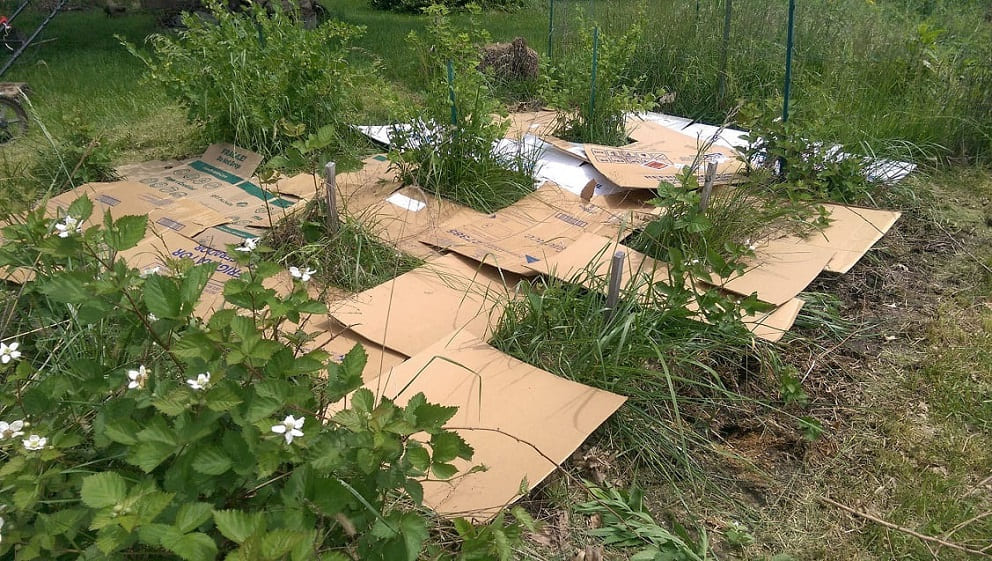
Smothering
For areas overrun with dandelions, cover the ground with cardboard topped by a thick layer (around eight inches) of organic matter such as wood chips.
This blocks light and kills existing plants and roots over time. Keep covered for at least one full growing season — preferably two — for complete effectiveness.
Deadheading
If you’re happy to coexist with dandelion plants but want to prevent seed spread, snip the flower heads as they begin to fade, before the puffball stage.
This is the best compromise strategy: maximum ecological benefit, minimum spread. A quick walk through the yard every few days during peak bloom is all it takes.
Bonus: removing flowers before seed set also directs more of the plant’s energy into root and leaf production, which matters if you’re harvesting for food.

Related posts:
- When and How to Deadhead Cosmos for Continuous Blooms
- How and Why to Deadhead Daylilies for Boosting Blooms
- How to Deadhead Salvia for Healthier Blooms And Extend Your Garden’s Beauty
Building a Healthier Lawn
The single most effective long-term strategy. Thick, vigorous turf simply outcompetes dandelions for space and light.
- Mow high.
Set your mower to 3–3.5 inches for most grass types. Taller grass shades the soil, making it harder for seeds to germinate.
Mowing too short is one of the most common mistakes homeowners make — and one of the biggest favors you can do for dandelions.
- Fertilize wisely.
Dandelions thrive in potassium-rich, low-nitrogen soils. Follow your local extension office’s nitrogen recommendations, and only apply potassium if a soil test shows a deficiency.
- Aerate compacted soil in fall.
Core aeration removes plugs of soil and sod, relieving the compaction dandelions exploit. Avoid aerating cool-season lawns in summer — the heat stress can damage turf.
- Overseed thin spots.
Dense turf leaves fewer bare patches for seeds to colonize.
- Adjust soil pH.
Dandelions prefer acidic soil. Agricultural lime or hardwood ash raises pH toward neutral, discouraging dandelions while improving grass health.
Flame Weeding
A propane-powered flame weeder scorches above-ground tissue, disrupting photosynthesis and eventually weakening the root through repeated applications.
Particularly useful for dandelions in gravel, sidewalk cracks, and patios — and admittedly satisfying to use. Keep it away from dry leaves, bark mulch, and anything flammable, and always have water nearby.

Herbicides (Use with Caution)
If non-chemical methods haven’t solved the problem, selective broadleaf herbicides containing 2,4-D, triclopyr, dicamba, or MCPP can control dandelions in lawns without killing grass.

Key considerations:
- Timing and application:
Late summer through early fall is the most effective window — dandelions are moving resources to their roots for winter, which transports systemic herbicides deeper into the plant.
Spot-treating individual plants is more effective and less damaging than broadcast spraying. The RHS notes that non-chemical methods are effective enough that weedkillers are generally unnecessary.
- What to avoid:
lyphosate is a poor choice — it knocks back leaves but frequently fails to kill the root, often causing the plant to regenerate in a harder-to-remove bushy form.
Household vinegar (5% acidity) is too weak. Horticultural vinegar (20%) burns foliage effectively but won’t kill roots and demands careful handling.
And despite internet popularity, there’s no scientific evidence that dish soap, Epsom salts, or similar home concoctions reliably kill dandelions.
- Safer alternatives:
Iron-based herbicides (containing FeHEDTA) deliver a dose of iron that dandelions can’t handle but grass tolerates. They typically require two applications and represent a lower-toxicity option.
Also worth noting: long-term UK studies found that potassium fertilizers increased dandelion density up to 20-fold — so simply reducing unnecessary potassium in your lawn fertilizer program is a surprisingly effective chemical-free strategy.
Eating Dandelions: A Garden-to-Table Guide
Nearly every part of the dandelion is edible. The flower stems contain a milky latex that’s quite bitter, so most people discard them, but technically even these can be consumed.
Humans have been eating dandelions since before Roman times, and for good reason: nutritionally, they rival or exceed many common salad greens.
Nutritional Highlights
Dandelion greens are packed with vitamins A, C, K, and B-complex, plus calcium, potassium, iron, magnesium, and manganese.
According to USDA data, they contain more vitamin A than spinach, more vitamin C than tomatoes, and are a meaningful source of protein for a leafy green.
The flowers are rich in antioxidants, particularly beta-carotene. The roots contain the prebiotic fiber inulin.
Leaves
Young, tender leaves harvested in early spring — before the first flower buds appear — have the mildest flavor: slightly bitter and earthy, comparable to arugula or radicchio.
As the season progresses and temperatures rise, bitterness intensifies.
To reduce it, you can blanch plants by covering them with a box or dark cloth for several days before harvest (the same technique used for endive, a close relative), or simply blanch picked leaves briefly in boiling water.
Uses: Fresh in salads, sautéed with garlic and olive oil, blended into pesto, wilted into soups and stews, tossed into omelets, or added to smoothies.

A classic preparation involves wilting the greens with a hot bacon vinaigrette — a tradition in Appalachian, Italian, and German cooking. In France and Germany, dandelion greens are commercially cultivated as a salad crop.
Flowers
Sweetest when picked freshly opened in early morning. The green bracts (the cup beneath the petals) can be bitter, so many cooks separate the yellow petals for a milder, slightly honey-like flavor.
Uses: Tossed into salads, battered and fried as fritters, steeped into tea, made into syrup, fermented into wine, or turned into dandelion jelly. The flowers can also be dried and ground into a yellow dye for textiles.

Roots
Best harvested from two-year-old plants in fall or early spring, when nutrient content peaks. Wash thoroughly and scrub like carrots.

Uses: Peeled and cooked like parsnips or turnips, dried and brewed into tea, or — most popularly — roasted at 200°F for about four hours until brittle, then ground into a caffeine-free coffee substitute with a rich, earthy flavor.
Some people enjoy it blended 50/50 with regular coffee for a milder transition. Dried roots also make excellent tinctures for herbal use.
Medicinal Traditions
Dandelion’s Latin species name — officinale — literally means “of the apothecary,” signaling its centuries-long role in medicine.
Across European, Chinese, and Indigenous traditions, different parts of the plant have been used to support liver function, aid digestion, reduce inflammation, and act as a gentle diuretic (hence the colorful old French name pissenlit — “wet the bed” — and the equally blunt English folk name “piss-a-bed”).
Modern preliminary research suggests potential benefits including blood sugar regulation and cholesterol reduction, though robust clinical evidence in humans remains limited.
What is well-established is the plant’s nutritional density — many historical ailments that dandelions “cured” were likely vitamin deficiency symptoms that the nutrient-rich plant simply corrected.
Important: Dandelion is a diuretic, and the roots have mild laxative properties.
Consult a healthcare provider before consuming dandelions medicinally, especially if you take blood thinners, diuretics, or diabetes medications. People allergic to ragweed, daisies, or latex may also react to dandelions.
Foraging Safety
- Never harvest from areas treated with herbicides, pesticides, or fertilizers — chemical residues can persist in soil for three to five years.
- Avoid roadsides where exhaust contaminants accumulate in plants.
- Don’t forage from other people’s yards — you don’t know what’s been sprayed or whose dog has visited.
- Wash everything thoroughly to remove soil, insects, and contaminants.
- If you’re unsure about your soil history, grow dandelions intentionally in a clean bed or buy them from a farmers’ market.
Growing Dandelions on Purpose
Yes, people intentionally cultivate dandelions — and it’s easier than almost any other edible plant you’ll ever grow.
Getting Started
Sow seeds directly outdoors after the last hard frost, when soil temperatures reach at least 50°F (10°C).
Press seeds lightly onto the soil surface without burying them — they need light to germinate. Keep the seedbed consistently moist with a fine mist. Expect germination within one to three weeks.
Space plants six to twelve inches apart for full-sized rosettes, or three inches apart if harvesting baby greens.
You can also start seeds indoors four to six weeks before the last frost and transplant seedlings when they’re three to four inches tall.
No garden? Deep containers on a balcony work well — just ensure at least six inches of soil depth for the taproot.

Growing Conditions
Dandelions tolerate almost anything, but for the tastiest greens:
- Light: Full sun to partial shade. Partial shade actually produces less bitter, more tender leaves — ideal for salads.
- Soil: Fertile, well-drained loam with a pH of 6.0–7.0. They’ll survive poor or compacted soil, but flavor improves in richer ground amended with compost.
- Water: Moderate and consistent. Drought stress intensifies bitterness.
- Fertilizer: Usually unnecessary in decent soil. In containers, a balanced organic fertilizer every six weeks is sufficient.
Harvesting and Storage
- Leaves:
Cut as close to the root as possible. The youngest, lightest-colored leaves are the most tender and mild. Harvest baby greens in spring, but you can pick leaves throughout the growing season.
Store fresh leaves in the fridge’s vegetable drawer for up to three days; wash and spin dry before using. For longer storage, bundle and hang upside down in an airy, shaded spot to dry.
- Flowers:
Pick when freshly opened and use the same day if possible — they close quickly after picking. To dry, remove stems and dehydrate at 95–104°F until crispy. Store dried flowers in sealed jars in a cool, dark place.
- Roots:
Harvest from plants at least two years old, in fall or early spring.
Wash well, chop into one-to-two-inch sections, and either air dry or dehydrate at 95°F until brittle. Roast dried roots at 200°F for four hours to make the coffee substitute.
Varieties for Growers
Beyond wild-type dandelions, cultivated varieties offer improved flavor:
- ‘Amélioré à Coeur Plein’ — Compact, dense clump; ideal for containers.
- ‘Vert de Montmagny’ (French dandelion) — Large, dark green leaves; mild flavor; early maturity.
Note: “Italian dandelion” sold in some catalogs is actually a type of chicory (Cichorium intybus), not a true dandelion. Similar-looking leaves but blue flowers and a different flavor.
The Only Real Maintenance Rule
Deadhead relentlessly. If you let flowers go to seed in a cultivated patch, you’ll quickly discover why your neighbors might not share your enthusiasm for this crop.
Remove every flower before it becomes a puffball — this also directs more energy into root and leaf production.
The Compromise Approach: How to Have Both a Tidy Yard and Happy Pollinators
For most gardeners, the sweet spot isn’t all-or-nothing. Here’s a practical framework:
Designate a dandelion zone
Allow dandelions to grow freely in a specific area — a wildlife corner, wildflower strip, or a section of lawn you leave unmowed through spring.
This approach aligns with the growing “No Mow May” movement, which encourages homeowners to delay the first mow until June, giving early-season pollinators uninterrupted access to dandelion nectar and other spring wildflowers.
Even a small patch makes a difference.
Enjoy the blooms, catch the seeds
Let flowers open for pollinators, but deadhead consistently as blooms begin to fade — before the puffball stage.
This is the single most impactful compromise: maximum ecological benefit, minimum spread.
Harvest what you remove
When you pull dandelions, don’t waste them.
Toss young leaves into salads, brew roots into tea, or make liquid fertilizer: stuff pulled plants tightly into a bucket, cover with water, lid it, and leave for six to eight weeks to ferment.
Strain the liquid (it will smell terrible), dilute one part concentrate to three parts water, and use it to feed garden plants. It’s potassium-rich liquid gold.
Compost the foliage wisely
Dandelion leaves break down well in a home compost bin. Avoid composting roots — they can regenerate in cool compost.
Lay roots on sunny pavement until completely dried and dead, or add them to municipal green waste bins that process at higher temperatures.
Read The Ultimate Guide to Easy Home Composting Techniques for Total Beginners
Frequently Asked Questions
Will mowing get rid of dandelions?
Not on its own. Mowing removes flower stalks and prevents some seed production, but it doesn’t kill the root — and dandelions adapt by producing shorter stalks that flower below the mowing height.
What mowing at the right height does is help grass outcompete dandelions by shading the soil and blocking seed germination. Think of tall mowing as a prevention strategy, not a cure.
Is dandelion root coffee actually good?
It’s a matter of taste. Roasted dandelion root produces a warm, earthy, slightly bitter brew.
It won’t fool a committed coffee drinker, but many people find it a satisfying caffeine-free alternative — especially blended 50/50 with regular coffee. The flavor deepens with longer roasting.
It’s worth trying at least once; dried dandelion root is available pre-roasted in tea bags at most health food stores if you want to sample before committing to a DIY batch.
Can dandelions harm my garden?
In moderate numbers, dandelions actually benefit gardens by aerating soil, cycling nutrients, and attracting pollinators that serve your other plants.
They become problematic mainly in thin lawns where they outcompete struggling grass, or in beds where their rosettes can smother small seedlings.
They can also harbor certain plant viruses (like tomato ringspot virus), so keep them away from sensitive fruit and vegetable crops if this is a concern in your area.
What’s the difference between a weed and a flower when it comes to dandelions?
Perception and location. As one extension agent put it: a weed is simply a plant that’s not wanted where it is.
Corn is a weed in a lawn; grass is a weed in a cornfield. Dandelions growing in a wildflower meadow or herb garden are a crop.
The same plant poking through a manicured lawn is a weed. You get to decide which framing applies in your yard.
Discover more Common Flowering Weeds: Complete Identification Guide
How do I make dandelion tea?
For leaf tea, add fresh or dried leaves to a strainer and steep in boiling water for five to ten minutes.
For root tea, chop fresh root and steep a tablespoon in five ounces of boiling water for thirty minutes.
For a richer, coffee-like version, roast dried root pieces at 200°F for several hours first, then steep for ten minutes.
Add honey or lemon to taste — the flavor is earthy and can be an acquired taste.
Key Takeaways
- Dandelions offer genuine ecological benefits — supporting pollinators, improving soil, cycling nutrients, and feeding wildlife — but they work best as part of a diverse planting, not as the whole show.
- Pollinator value is real but limited. They’re helpful early-season food, not a complete diet. Plant native blooms alongside them for maximum impact.
- Nearly every part is edible, nutritious, and medicinally valued — with a history spanning thousands of years and culinary traditions across the globe.
- The best long-term removal strategy is a healthy lawn — tall mowing, smart fertilization, core aeration, and overseeding address the root causes rather than the symptoms.
- The smartest approach for most people is compromise: keep a patch for wildlife, deadhead to prevent spread, harvest for food or fertilizer, and focus on building healthy soil.
Your Turn
Next spring, before you reach for the weed killer, try picking a handful of young dandelion leaves for a salad instead. Or brew a cup of roasted root tea.
Or simply pause to watch a bumblebee work through those golden florets in the early morning light. You might find that the plant you’ve been fighting is one you’d rather befriend.
What’s your dandelion strategy — embrace, evict, or somewhere in between?
Share your approach in the comments, and if you found this guide helpful, pass it along to a fellow gardener staring down their own golden lawn this spring.
source https://harvestsavvy.com/benefits-of-dandelions/


No comments:
Post a Comment